Particle Size & Zeta Potential
Laser diffraction and dynamic light scattering verify sub-micron particle distribution and electrostatic repulsion stability.

Science & Formulation
Explore the polymer physics, ionic stabilization mechanisms, and bio-based synthesis behind Kshetragna Agronym’s waterborne dispersion platform.
Colloidal Engineering
Polyurethane dispersions (PUDs) are binary colloidal systems where polyurethane polymer particles are stably dispersed in a continuous water phase. Rather than relying on external surfactants that degrade film water-resistance, Kshetragna Agronym employs internal ionic groups (such as carboxylate and sulfonate moieties) built into the polymer backbone.
During the prepolymer mixing process, these ionic centers self-orient towards the water interface, forming microscopic particles (typically 50 to 200 nanometers) that deliver extraordinary shelf stability, film clarity, and coalescence properties upon drying.
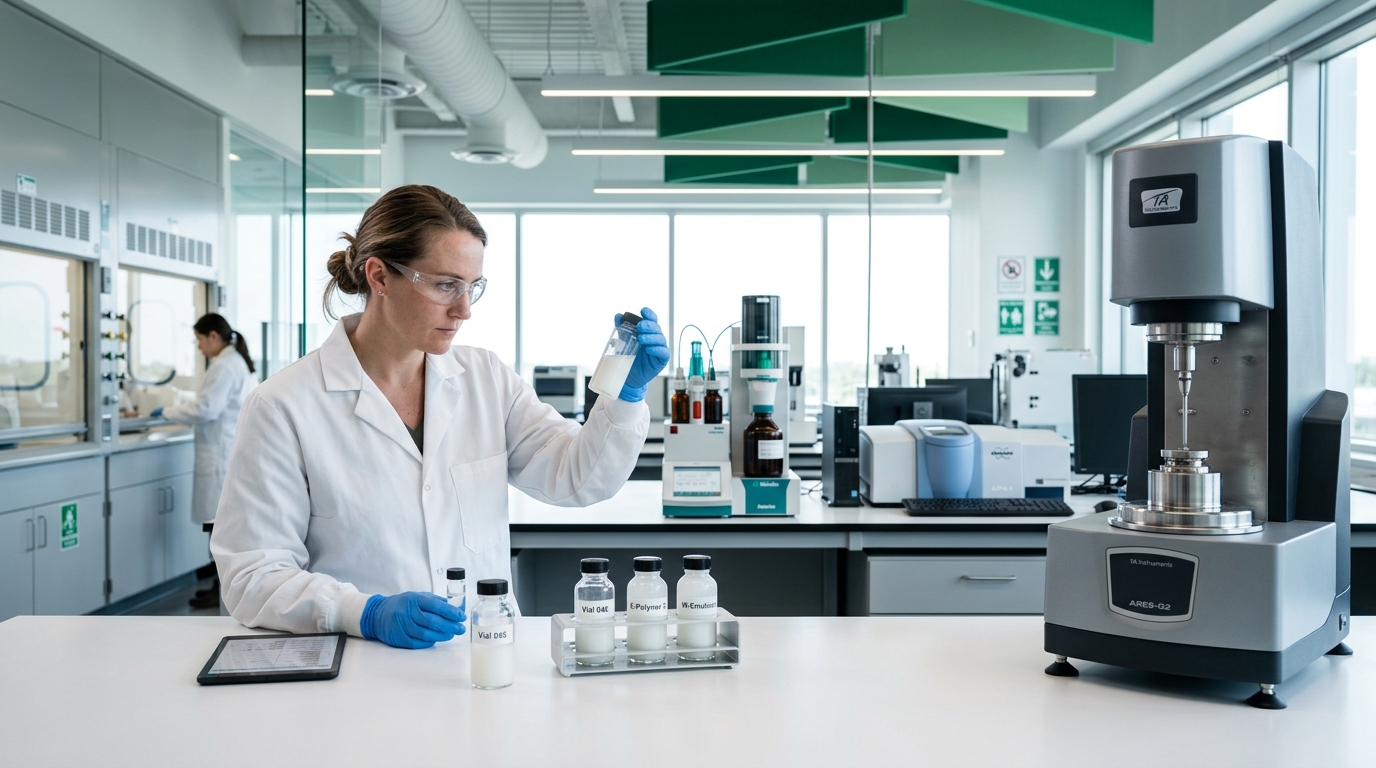
Evaluating particle size distribution, minimum film-forming temperature (MFFT), and mechanical tensile properties in our Hyderabad facility.
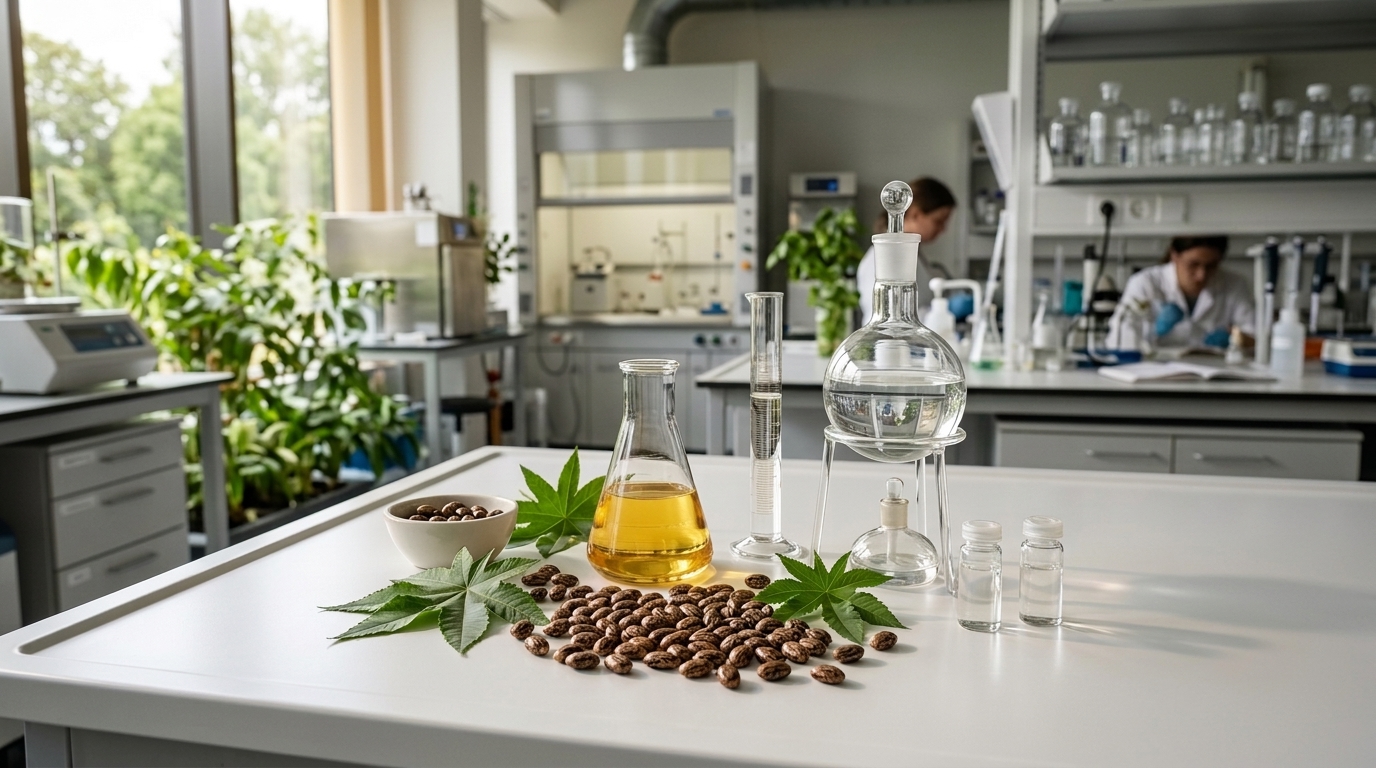
Utilizing non-food ricinoleic acid derivatives to engineer polyester and polyether polyol segments with natural hydrophobicity and elasticity.
Renewable Feedstocks
Castor oil (Ricinus communis) possesses a unique chemical structure: an 18-carbon fatty acid chain featuring a natural hydroxyl group on the 12th carbon and a double bond on the 9th carbon.
This natural functionality makes castor oil an ideal bio-polyol for polyurethane synthesis. It imparts intrinsic flexibility, water resistance, and low-temperature elasticity without relying on petrochemical plasticizers.
✓ Renewable Carbon Content: Up to 50%+ bio-carbon in designated ERANDIQ™ grades
✓ Zero Added NMP / NEP: Meets strict European and global fashion brand restricted substance lists (RSL / ZDHC)
✓ Thermal & Hydrolytic Stability: Resists aging, moisture exposure, and UV yellowing
Quality & Analytical Verification
Every laboratory batch and production lot undergoes comprehensive analytical characterization prior to customer qualification.
Laser diffraction and dynamic light scattering verify sub-micron particle distribution and electrostatic repulsion stability.
Testing shear-thinning behavior to ensure flawless atomization through spray nozzles and uniform leveling on roller coaters.
Free film and substrate-applied testing evaluating modulus, elongation at break, and cyclic fatigue resistance.
Ensuring compliance with Zero Discharge of Hazardous Chemicals (ZDHC) and global leather working group guidelines.
Our polymer synthesis team can help you identify or tailor the right dispersion parameters for your substrate and process equipment.
Connect with Technical Support →